
01 · Situation
Plenty of ideas. Not enough hands.
Leadership wanted continuous improvement. But a few hard years, thin bandwidth, and few champions had kept it on the wish list.
So we didn’t start with a big program. We started with two focused Kaizen events, each four days long, each with the people who actually do the work.
02 · Problem
Paint it twice. Wait overnight. Repeat.
On the grinder line, cast parts were painted on the inside only. Once the grinder was assembled, the whole unit went back to paint for its outside coat. Some went back a third time after the drive was installed.
- Every coat meant at least one night of drying, sometimes three
- Parts and grinders traveled 1,480 feet, about a quarter mile
- Moving heavy grinders was one of the riskiest jobs in the plant
- Value stream mapping showed 85% of the time was non-value-added
In seal assembly, the team built in batches of 100. Half-finished seals sat out all day, sometimes overnight, with grease exposed. The operator waited over a minute per seal, holding down a foot pedal on the press.
03 · Action
Paint once. Build one at a time.
- Painted parts Kanban. Castings are now fully painted in one pass and staged where assembly uses them, replenished by a Kanban signal.
- Standard work, start to finish. Clear steps for sandblasting and painting, handling painted parts, capturing labor, and issuing material to work orders.
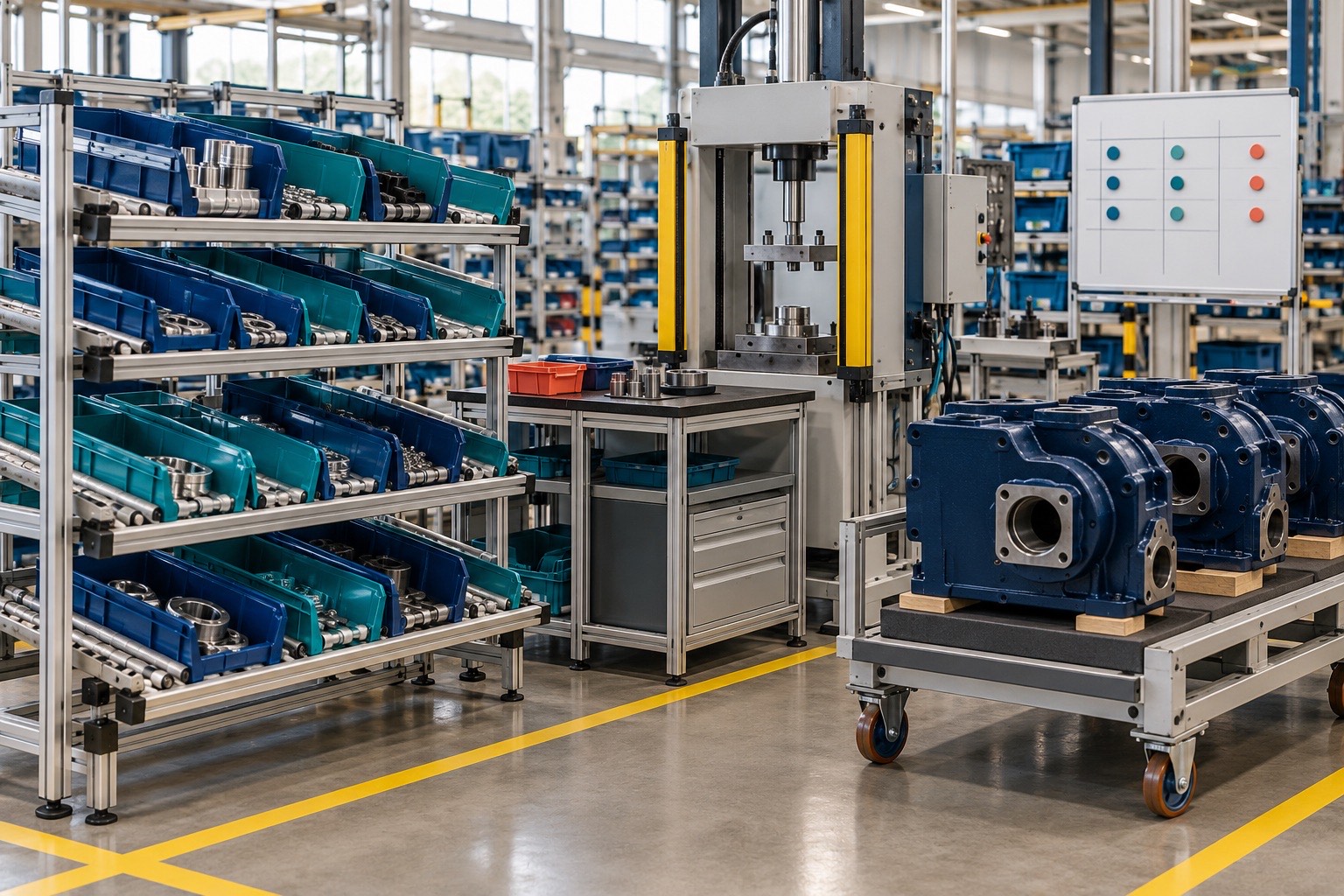
- One-piece flow seal cell. We replaced batch assembly with a compact cell and gravity-flow racks fed by Kanban.
- A smarter press. Basic automation on the hydraulic press freed the operator to keep assembling while it cycles.
- Train everyone it touches. Stockroom, paint, assembly, QC, and shipping all learned the new flow together.
04 · Result
Less walking. Less waiting. More building.
Grinder assembly labor dropped from 9 hours to about 6. Travel fell 33%, and painting in one pass took 1 to 2 days off turnaround. Non-value-added time came down from 85% to 66%.
In the seal cell, cycle time dropped from 138 to 84 seconds a seal, about 40% less. The area shrank 44%, and nearly all of the remaining time is value-added work.
Kaizen 1 · Painted parts Kanban
Grinder assembly labor hours per grinder
Non-value-added time share of total time
Kaizen 2 · Seal assembly cell
Seal cycle time seconds per seal
The seal assemblers started the week wanting to keep things as they were, with little confidence the change would work. By the end, they were helping drive it, and believed in the new way.
That’s the tipping point toward a Kaizen culture.